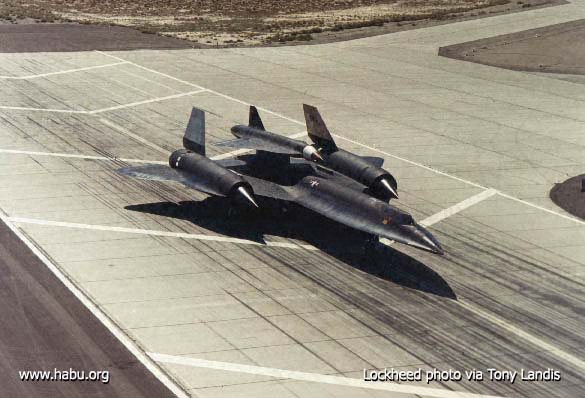
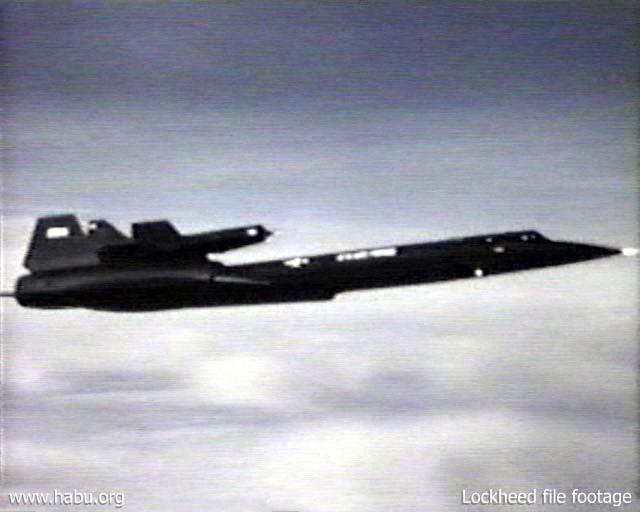
 941 was one of two M-21s used as a launch platform for the D-21 drone. 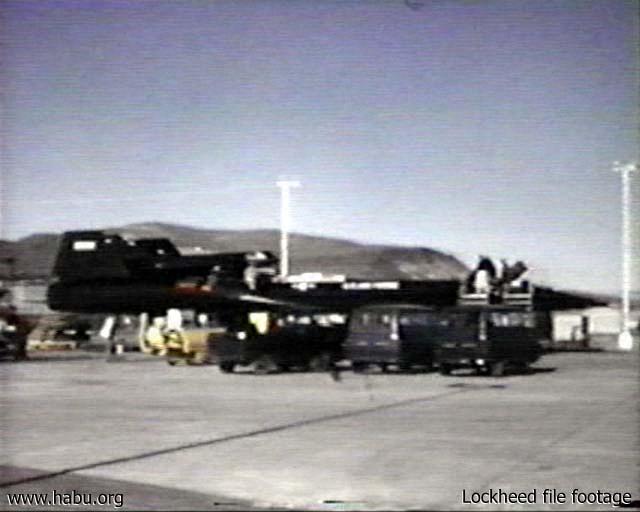 When mated with the drone, the combination was known as an "M/D-21." Contrary to some reports, both 941 and her sister ship 940 were built from the ground up to be M-21s, and were not "converted" from existing A-12s. Unlike 940, in most photos 941 appears painted all black, and was the only M/D-21 used in actual D-21 launches (all of 940's M/D-21 flights were load and aerodynamic test flights). 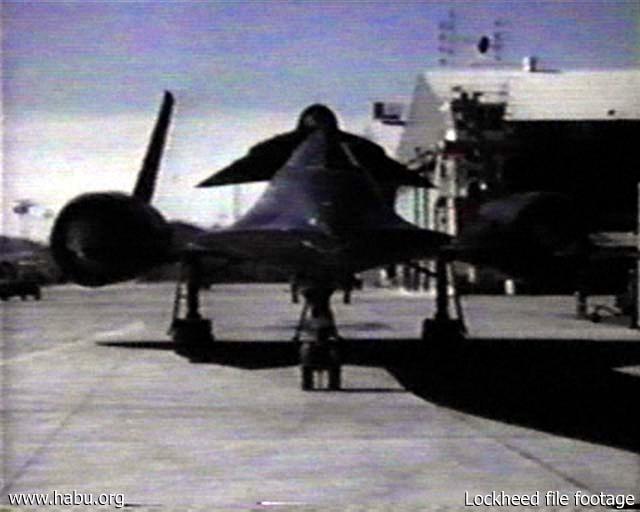
Lockheed file footage showing 941 taxiing with D-21 #506 mounted She was lost on Saturday, July 30, 1966. Prior to this flight, there had been 3 successful D-21 launches from 941, but all 3 had been executed with the mothership in a .9g "dive," flying slightly downward to assist in blackbird/drone separation. If the still-experimental M/D-21 were to be used in combat (real-world) missions, the crew might be under fire from missiles and fighter/interceptors, and so might not have the luxury of launching from a .9g dive. In this fourth launch, the D-21 would separate in a level-flight, 1g configuration.
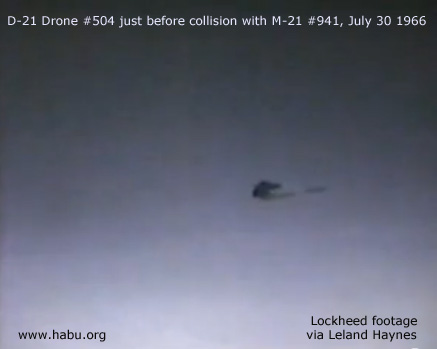
For the first 2 to 3 seconds of the drone launch, everything went normally. Unfortunately, the drone was not able to penetrate the shock wave coming off the mothership. The D-21 (#504) had almost cleared the M-21's rudders when it encountered the shock wave, bounced off, rolled 45 degrees to the port (left) side, and impacted the mothership almost directly at Station 715, where the forward fuselage attaches to the wing root. Between the impact and resulting explosion, #941 was for all intents and purposes cut cleanly in two. Leland Haynes posted video of the accident at this link: http://www.youtube.com/watch?v=GMyC2urCl_4. Lockheed test pilot Bill Park and Launch Control Officer Ray Torick remained in the tumbling wreckage until a lower altitude where they ejected safely, but they landed in the open ocean, and Torick drowned when his pressure suit took on water. Some reports attribute this to Torick prematurely opening the faceplate of his visor, but other informed sources have stated that the bouyancy of the David Clark suits would make this almost impossible. Others have speculated that his suit was torn by schrapnel from the wreckage as he ejected. In either case, no further M/D-21 flights occured; furthermore, a baylor bar was then added to the flight suit helmets to ensure that the faceplate could not accidentally be opened in similar situations. All M/D-21 operations ended with the death of Ray Torick. All subsequent flights of the D-21 were as D-21B's, which were reconfigured to launch the drone from an underwing pylon of a B-52 (much like the X-15 had been), boosted to Mach 3 by a rocket motor that was jettisoned after the D-21B's Marquardt ramjet was started. 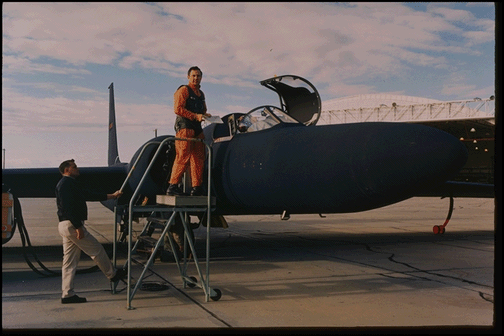 Lockheed test pilot Bill Park, who piloted all M/D-21 flights, shown here boarding a U-2R/TR-1 (photo courtesy Lockheed Martin) |